Oct 7, 2025
Bitcoin ETF Flows Are Set To Accelerate

Matt Hougan
Chief Investment Officer
Our prediction: Q4 flows into bitcoin ETFs will set a record. Here are three reasons why.
At the start of the year, we predicted that bitcoin ETFs would pull in more money in 2025 than they did in their record-setting first year, when they attracted $36 billion.
Looking at the chart, you might think we’re getting nervous. Through the first nine months of the year, bitcoin ETFs have pulled in $22.5 billion, putting them on pace to end the year with about $30 billion in flows.¹ That’s impressive, but shy of the 2024 high-water mark.
Gold vs. Bitcoin: ETF Inflows by Year
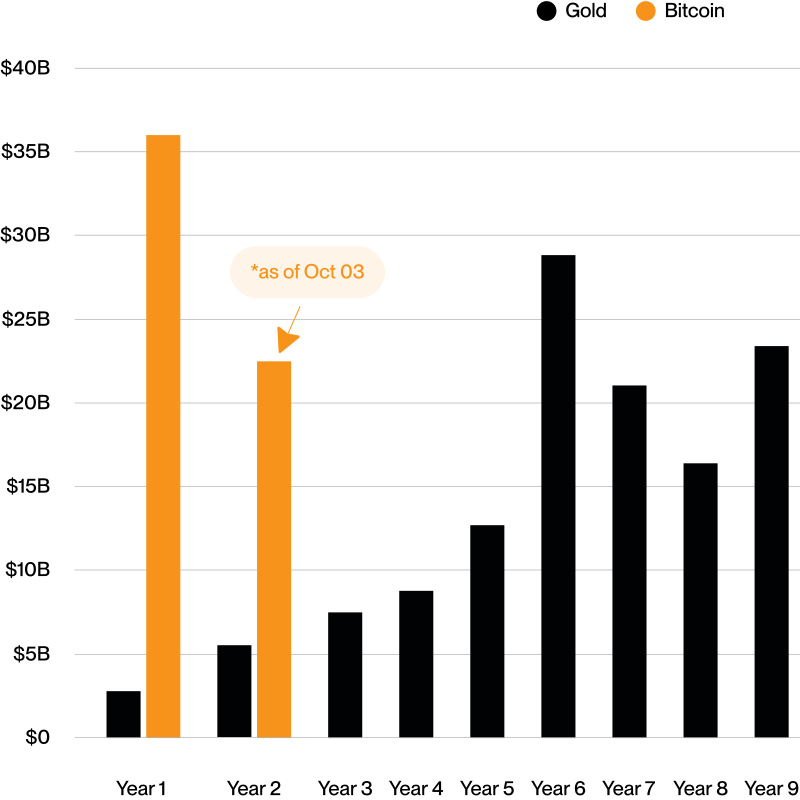
Source: Bitwise Asset Management with data from ETF.com, Farside Investors, and Bureau of Labor Statistics. Data as of October 3, 2025, adjusted for inflation. Past performance is not an indicator of future results.
Here's a hot take: I’m not worried.
From where I sit, the stars are aligned for a very strong Q4 for flows—more than enough to push us to a new record (and a new all-time high in bitcoin’s price).
Here are three reasons why.
1. We Finally Got Platform Approvals
Until very recently, the largest wealth managers in the world have been prohibited from buying bitcoin ETFs. That is finally changing. On October 1, the Global Investment Committee of Morgan Stanley—which guides 16,000 advisors managing $2 trillion—published a report titled “Asset Allocation Considerations for Cryptocurrency.” The landmark report states that financial advisors and clients at the firm may now “flexibly allocate to cryptocurrency as part of their multiasset portfolio.” It suggests allocations up to 4% can be appropriate for risk-tolerant investors.
Morgan Stanley's Recommendations for Maximum Crypto Allocations in Multiasset Portfolios

Source: Morgan Stanley Wealth Management Global Investment Committee and Bloomberg. Data as of September 30, 2025.
Morgan Stanley is not alone. Wells Fargo (roughly $2 trillion in AUM) also recently pivoted, allowing advisors to allocate on behalf of clients. I suspect UBS, Merrill Lynch, and others are not far behind.
I don’t expect all advisors at these firms to flood into bitcoin ETFs immediately. New guidance takes time to process, particularly when we’re talking about tens of thousands of financial professionals. But I can tell you this from the many conversations we’ve had with advisors in recent months: There is serious pent-up demand here, and I expect meaningful flows in Q4.
2. The “Debasement Trade” Is the Trade of the Year
The best-performing major assets in the world this year are gold and bitcoin.
Wall Street has a term for this: “The Debasement Trade.” It means investing in assets that are poised to do well if governments debase or degrade their currencies. And debase they have: Since 2020, the U.S. money supply has increased 44%. JPMorgan put out a major report on the debasement trade on October 1, a clear sign that this trade is going mainstream.
Why does this matter? Because when advisors sit down with their clients for their annual review, they want their year-end print outs to show that they hold the most successful investments. There’s only one way to do that: By buying gold and bitcoin.
Last year, everyone wanted Nvidia on their annual report. This year, they want gold and bitcoin. I suspect you’ll see strong flows through year’s end as advisors get on the debasement train.
3. Bitcoin Is Surging
The third—and most fundamental—reason I suspect we’ll see high flows is that I’m bullish on bitcoin returns for Q4. We’re already at all-time highs, having broken free from the $100,000 psychological barrier to trade north of $125,000 per bitcoin. Bitcoin’s price is up 9% in the first week of October alone. And although it’s a bit counterintuitive, higher prices often spur greater demand for bitcoin ETFs as the media, companies, and everyday investors pivot their attention to bitcoin.
In fact, while correlation does not necessarily imply causation, in every quarter where there has been a double-digit positive return for bitcoin, there have also been double-digit billions in inflows to bitcoin ETFs.
Bitcoin ETF Inflows vs. Bitcoin Returns

Past performance does not guarantee future results.
Q4: So Far, So Good
It’s worth noting that Q4 is off to a great start. In the first four trading days of the quarter, we’ve already had $3.5 billion in net flows, bringing total YTD flows to $25.9 billion.
We have 64 more days to get another $10 billion. I think we’ll do that and then some.
Note:
(1) Bitcoin ETFs launched on January 11, 2024; as a result, performance figures for 2024 are based on 242 total trading days. To ensure we’re comparing apples-to-apples, our predictions for 2025 are based on the first 242 trading days of the year, or until December 18.
Risks and Important Information
No Advice on Investment; Risk of Loss: Prior to making any investment decision, each investor must undertake its own independent examination and investigation, including the merits and risks involved in an investment, and must base its investment decision—including a determination whether the investment would be a suitable investment for the investor—on such examination and investigation.
Crypto assets are digital representations of value that function as a medium of exchange, a unit of account, or a store of value, but they do not have legal tender status. Crypto assets are sometimes exchanged for U.S. dollars or other currencies around the world, but they are not currently backed nor supported by any government or central bank. Their value is completely derived by market forces of supply and demand, and they are more volatile than traditional currencies, stocks, or bonds.
Trading in crypto assets comes with significant risks, including volatile market price swings or flash crashes, market manipulation, and cybersecurity risks and risk of losing principal or all of your investment. In addition, crypto asset markets and exchanges are not regulated with the same controls or customer protections available in equity, option, futures, or foreign exchange investing.
Crypto asset trading requires knowledge of crypto asset markets. In attempting to profit through crypto asset trading, you must compete with traders worldwide. You should have appropriate knowledge and experience before engaging in substantial crypto asset trading. Crypto asset trading can lead to large and immediate financial losses. Under certain market conditions, you may find it difficult or impossible to liquidate a position quickly at a reasonable price.
The opinions expressed represent an assessment of the market environment at a specific time and are not intended to be a forecast of future events, or a guarantee of future results, and are subject to further discussion, completion and amendment. The information herein is not intended to provide, and should not be relied upon for, accounting, legal or tax advice, or investment recommendations. You should consult your accounting, legal, tax or other advisors about the matters discussed herein.