Aug 13, 2025
Four Things That the Crypto Market Hasn’t Priced In

Matt Hougan
Chief Investment Officer
People are bullish on crypto for obvious reasons. But there are still things the market is overlooking.
There’s a lot to be excited about in crypto right now. Regulation and legislation are moving in a positive direction; stablecoins are taking off; corporate purchases of crypto are soaring; institutions are slowly but surely adding crypto to their portfolios via ETFs; and Ethereum has gotten its mojo back, injecting some much-needed altcoin energy into the broader crypto market.
The problem—if there is one—is that all of these are well-known. I generally think the market is underestimating the scale of each of these developments, but it’s not as if they are happening without people noticing. The media is full of stories about the bull market in crypto.
Still, I think there are significant upside surprises in store for the market through the end of the year—enough to push prices substantially higher. Here are four big developments that I think are not priced into the market.
1. More Governments Will Buy Bitcoin This Year
At the start of 2025, the common belief was that there would be three big sources of demand for bitcoin this year: ETFs, corporations, and governments. We called them "The Three Horsemen of Bitcoin Demand."
So far, two of those horsemen have delivered: ETFs have purchased 183,126 BTC, while public corporations have gobbled up 354,744 BTC. Given that the bitcoin network has only produced 100,697 bitcoin, that’s been enough to drive the price up 27.1%.
But the third horseman hasn’t really showed up. Sure, the U.S. established a Strategic Bitcoin Reserve, but it only holds bitcoin that it seized through criminal forfeiture. And sure, Pakistan announced the creation of its own bitcoin reserve and Abu Dhabi invested in bitcoin ETFs, but these have been dribs and drabs compared to the thunderous purchases by ETFs and corporations.
The popular conception is that sovereign adoption of bitcoin as a reserve asset has fallen off the table. I suspect this is wrong. Countries and central banks move slowly, but based on the conversations we’re having at Bitwise, they are moving.
To be clear: I don’t think there will be a rush of national announcements by year-end, but I do suspect there will be a few more—enough to establish this as a major potential catalyst for 2026. That realization alone could push prices substantially higher.
2. Lower Dollar + Lower Interest Rates = Higher Bitcoin
One unique aspect of the current moment is that bitcoin is trading near all-time highs while interest rates hover near their highest levels since bitcoin was created in 2009. That’s not supposed to happen. High interest rates are a challenge for non-yielding assets like bitcoin (and gold) because they create a high hurdle rate for holding the asset.
The market is pricing in multiple rate cuts by year-end, which should be supportive for bitcoin. But I think the market is missing a much bigger story here.
The Trump Administration has a strong desire for both a weaker dollar and a more dovish Federal Reserve. From direct criticism of Fed Chair Jerome Powell to the appointment of weak-dollar advocate Stephen Miran to the Federal Reserve Board of Governors, the Administration is strongly signaling that it wants much lower rates and a much weaker dollar.
Not three rate cuts. Try six. Or eight.
The Miran appointment in particular is worthy of attention. Miran is best-known for papers arguing that the dollar’s role as the world’s reserve currency puts enormous burdens on the United States. He has called for a new “Mar-a-Lago Accord” to reduce the value of the dollar against its global peers, and has suggested the Fed can achieve this goal by printing large numbers of dollars.
If we get much lower rates and a much weaker dollar due to money printing, bitcoin could trade significantly higher.
3. Lower Volatility Means Higher Allocations
One of the most under-reported trends in crypto is the dramatic reduction in bitcoin’s volatility. Both bitcoin’s volatility, and the rate at which its volatility is changing, have fallen dramatically since the launch of spot bitcoin ETFs in January 2024.
Bitcoin Rolling 30-Day Volatility
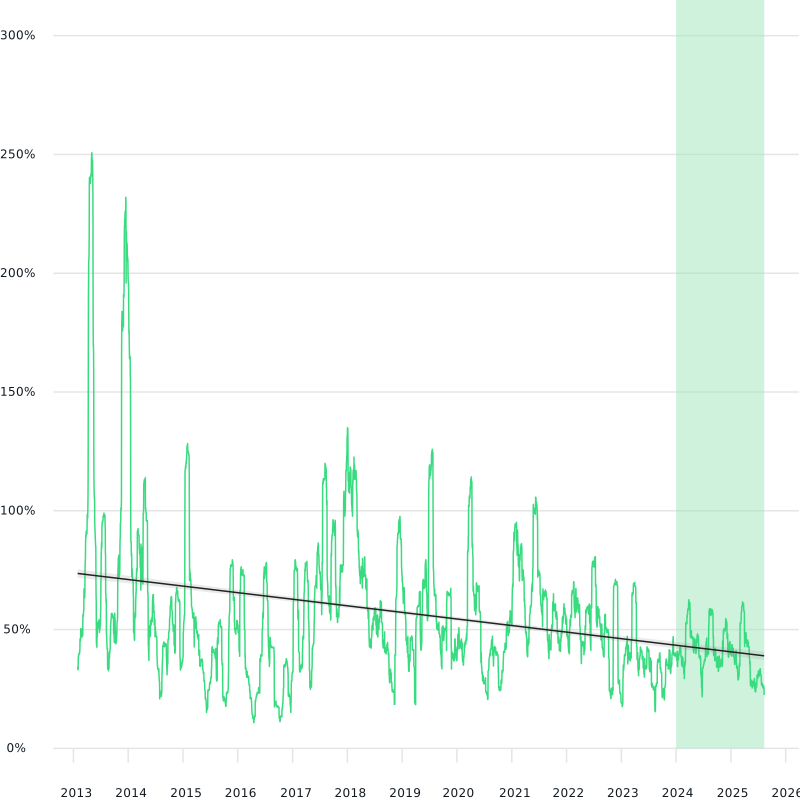
Source: Bitwise Asset Management with data from Coin Metrics. Data from December 31, 2012 to August 10, 2025.
Note: The green shading shows the period since the launch of spot bitcoin ETFs.
The drop in volatility makes sense. The growth of ETFs and corporate purchases injected new types of buyers into the crypto market, and advances on the regulatory and legislative side dramatically reduced risk in the market. I suspect this is the “new normal” for bitcoin. It is now roughly as volatile as high-volatility tech stocks, like Nvidia.
Volatility: Bitcoin vs. Tesla, Nvidia, and Meta
1-Year Rolling Annualized Volatility
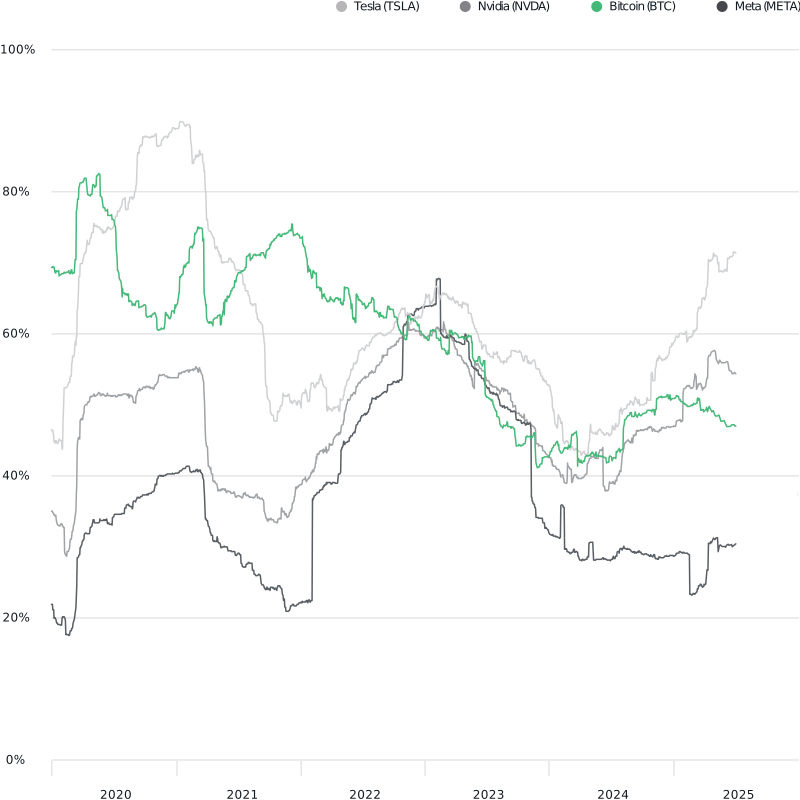
Source: Bitwise Asset Management with data from Bloomberg. Data from December 31, 2019 to June 30, 2025.
In my conversations with institutional investors, this lower volatility is translating into much higher portfolio allocation considerations than in the past. Whereas 1% was the primary starting point for conversations in the pre-ETF era, I now regularly hear talk of starting at 5% or more.
This is a big part of the reason why bitcoin ETF flows are accelerating (they’ve done $5.6 billion in net flows since July 1, which would work out to close to $50 billion in flows over a year). The fact that summer is traditionally a slow period for ETF inflows tells me this trend is likely to continue to accelerate in the fall.
4. ICOs 2.0: The Rebirth of Crypto Capital Raising
Initial Coin Offerings (ICOs) have a terrible reputation. In 2018, fraudulent ICOs—paper projects that raised billions from investors, only to run off with the money and never ship—were a big reason why the crypto bull market of 2017 ground to a halt. The SEC cracked down, and investors got tired of the shenanigans.
I think most investors and observers have written off ICOs as damaged goods. But in his recent “Project Crypto” speech, SEC Chair Paul Atkins laid out a vision for a rebirth of ICOs:
“I have asked staff to propose purpose-fit disclosures, exemptions, and safe harbors … for so-called “initial coin offerings,” “airdrops,” and network rewards. … It is my view that a Cambrian explosion in innovation could occur if we stay true to this course.”
If this happens, I think it could be a significant upside catalyst. Crypto investors have historically been eager to invest in crypto projects—both during the ICO boom and after it. Unleashing a new ICO Market 2.0 could draw in significant new capital to the crypto market.
Conclusion
Markets don’t rise on good news. They rise on good news that is not priced in.
I think the market in general underappreciates the scale of the bull market taking place in crypto. But I also think it's overlooking some specific catalysts that will play out in the months and years to come.
Look out above for higher prices.
Risks and Important Information
No Advice on Investment; Risk of Loss: Prior to making any investment decision, each investor must undertake its own independent examination and investigation, including the merits and risks involved in an investment, and must base its investment decision—including a determination whether the investment would be a suitable investment for the investor—on such examination and investigation.
Crypto assets are digital representations of value that function as a medium of exchange, a unit of account, or a store of value, but they do not have legal tender status. Crypto assets are sometimes exchanged for U.S. dollars or other currencies around the world, but they are not currently backed nor supported by any government or central bank. Their value is completely derived by market forces of supply and demand, and they are more volatile than traditional currencies, stocks, or bonds.
Trading in crypto assets comes with significant risks, including volatile market price swings or flash crashes, market manipulation, and cybersecurity risks and risk of losing principal or all of your investment. In addition, crypto asset markets and exchanges are not regulated with the same controls or customer protections available in equity, option, futures, or foreign exchange investing.
Crypto asset trading requires knowledge of crypto asset markets. In attempting to profit through crypto asset trading, you must compete with traders worldwide. You should have appropriate knowledge and experience before engaging in substantial crypto asset trading. Crypto asset trading can lead to large and immediate financial losses. Under certain market conditions, you may find it difficult or impossible to liquidate a position quickly at a reasonable price.
The opinions expressed represent an assessment of the market environment at a specific time and are not intended to be a forecast of future events, or a guarantee of future results, and are subject to further discussion, completion and amendment. The information herein is not intended to provide, and should not be relied upon for, accounting, legal or tax advice, or investment recommendations. You should consult your accounting, legal, tax or other advisors about the matters discussed herein.